
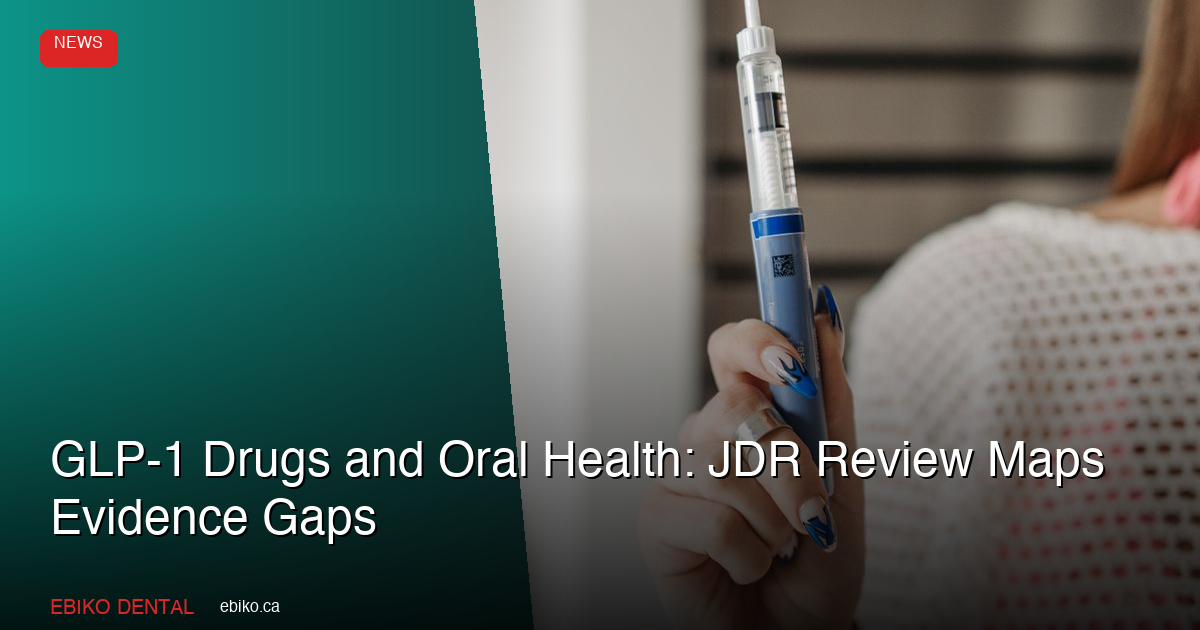
TL;DR: A critical appraisal published online on October 14, 2026 in the Journal of Dental Research reviews what is known about GLP-1 receptor agonists (the drug class that includes semaglutide) and oral health. Animal and lab studies point to possible periodontal and bone benefits, while pharmacovigilance reports and gastrointestinal side effects raise possible risks, but the authors found that no prospective study has yet used a dental outcome as an endpoint.
GLP-1 receptor agonists have moved from diabetes clinics into everyday conversation, and the patients in your chair are part of that shift. As of October 2026, a new paper in the Journal of Dental Research asks a question many dental professionals have been asking informally: what do these drugs mean for the mouth? The short answer from the authors is that the evidence is promising in some areas, worrying in others, and thin almost everywhere.
What did the Journal of Dental Research paper review?
The paper, titled "GLP-1 Receptor Agonists in Dentistry: Promise, Pitfalls, and Evidence Gaps," was first published online on October 14, 2026. Its six authors, with N. Werner listed first and F. Schwendicke listed last, are all listed with the Department of Conservative Dentistry, Periodontology and Digital Dentistry at LMU University Hospital in Munich, Germany.
The authors describe the work as a critical appraisal. According to the abstract, it synthesizes the evidence across multiple dental disciplines, grades that evidence in each domain, and identifies the gaps that need investigation. It appraises existing evidence rather than reporting a new clinical trial.
The authors set the scene with a striking figure: they describe GLP-1RAs as one of the fastest-growing drug classes worldwide, with prescriptions for obesity treatment rising by 587% from 2019 to 2024. Their point is simple. The metabolic and cardiovascular benefits of these drugs are well established, yet the implications for oral health "remain largely unexamined."
Where does the evidence look promising?
The most encouraging findings sit in periodontal and implant biology. The authors report that preclinical evidence consistently shows anti-inflammatory and osteoprotective effects on periodontal and peri-implant tissues. Specifically, the abstract lists three lines of laboratory and animal evidence:
- GLP-1RAs promote osteogenic differentiation of periodontal ligament stem cells.
- They reduce alveolar bone resorption in animal models of periodontitis.
- They enhance implant osseointegration in diabetic rats.
That is the promise. The catch follows immediately: the authors stress that these findings come exclusively from in vitro and animal studies, with only a single retrospective cohort study offering limited clinical data. For your practice, that means there is no basis yet for telling a patient that their GLP-1 medication will help their gums or their implant.
Pro Tip: When a patient asks whether their new medication will "help their gums," a fair answer today is that lab and animal research is interesting but human evidence is still missing. Record the medication and keep treating periodontal disease on its own clinical merits.
What are the possible oral risks?
On the other side of the ledger, the authors flag two groups of concerns.
Reported oral adverse effects
Pharmacovigilance analyses, which collect reported side effects after a drug is on the market, have included xerostomia (dry mouth), dysgeusia (altered taste) and anosmia (loss of smell), particularly for semaglutide. Reports of this kind signal a possible association; they do not measure how often the effect happens or prove that the drug caused it.
Gastrointestinal effects and the teeth
The second concern is indirect. The authors cite nausea in 15% to 50% of patients, vomiting in 5% to 24%, and gastroesophageal reflux as known gastrointestinal side effects. In their words, these pose a "plausible but unquantified" risk for tooth erosion and secondary caries. Note the wording: plausible, not proven. According to the authors, no prospective study has yet used a dental outcome, such as erosion or caries, as an endpoint in people taking these drugs.
Why does the oral microbiome matter here?
The paper adds a third layer that is easy to miss. The authors describe a bidirectional link between GLP-1 signalling and the oral microbiota, mediated by bacterial dipeptidyl peptidase (DPP)-4-like enzymes that degrade the body's own GLP-1. In plain terms, oral bacteria may influence GLP-1 activity, and GLP-1 activity may influence the oral environment. The authors present this as added complexity rather than a settled mechanism, and it is one more reason they call for dedicated research.
What is the biggest gap the authors identified?
The central finding of the appraisal is an absence. Despite the breadth of possible interactions, the authors state that no prospective study has used any dental outcome as an endpoint in patients receiving GLP-1RAs. Apart from one retrospective cohort study with limited clinical data, the appraisal describes the evidence on teeth, gums and implants as coming from lab work, animal models, side-effect reports and reasoning from known gastrointestinal effects.
That gap matters for two reasons. First, it means dental professionals should be cautious with any confident claim in either direction, whether it comes from a patient forum or a product brochure. Second, it points to the kind of study the authors want to see next: prospective research that follows patients on these drugs and measures dental outcomes directly.
What should dental practices in Toronto and the GTA do now?
None of the following comes from the paper itself. These are practical steps that follow from its conclusion that the evidence is incomplete.
- Ask directly at every medical history update. Patients do not always think of a weekly injection as "a medication." Ask by name about diabetes and weight-management drugs so the record is complete.
- Look for erosion and dry mouth with fresh eyes. If a patient reports frequent nausea, vomiting or reflux, document it and assess for erosive wear and caries risk as you would for any patient with those symptoms.
- Be honest about the evidence. Patients in Mississauga, Markham or Scarborough who ask about their medication deserve an accurate answer: the research on oral effects is early, and no drug change should happen without their prescribing physician.
- Stay in your lane on prescribing. Questions about stopping, starting or changing a GLP-1RA belong with the patient's physician. Your role is to identify oral findings and communicate them.
Pro Tip: Add a single line to your medical history form, such as "Are you taking any medication for diabetes or weight management, including weekly injections?", and review the answer at each recall. It takes seconds and closes a common documentation gap.
Sources
- Werner N, Pitchika V, Bumm CV, Heck K, Folwaczny M, Schwendicke F. "GLP-1 Receptor Agonists in Dentistry: Promise, Pitfalls, and Evidence Gaps." Journal of Dental Research, first published online October 14, 2026. doi:10.1177/00220345261488338 (PMID 42873199; record via Europe PMC)
Frequently Asked Questions
Q: Do GLP-1 drugs like semaglutide cause tooth erosion?
It is not proven. A 2026 critical appraisal in the Journal of Dental Research describes nausea, vomiting and reflux from these drugs as a "plausible but unquantified" risk for erosion and secondary caries, and notes that no prospective study has yet measured dental outcomes in people taking them.
Q: Can GLP-1 receptor agonists help with gum disease?
Only lab and animal evidence suggests a possible benefit. The appraisal reports anti-inflammatory and bone-protective effects in preclinical studies, but human evidence is limited to a single retrospective cohort study, so a clinical benefit has not been established.
Q: What oral side effects have been reported with semaglutide?
According to the appraisal, pharmacovigilance analyses have reported xerostomia (dry mouth), dysgeusia (altered taste) and anosmia (loss of smell), particularly for semaglutide. These are reported associations, not measured rates.
EBIKO Dental will continue monitoring research on GLP-1 medications and oral health and will report on the first prospective studies with dental endpoints as they are published. For more news and supply resources for Canadian practices, visit EBIKO Dental.