
The first quarter of 2026 has brought a wave of dental technology milestones, from laser-assisted root canal systems that eliminate the need for sodium hypochlorite to the first dental-dedicated MRI cleared for clinical use. As of April 2026, Canadian dental practices are watching these innovations closely as they reshape clinical workflows and patient care standards.
As of April 2026, the pace of technological innovation in dentistry is accelerating. Several developments from Q1 have particular relevance for Canadian dental professionals, both for their clinical applications and for the regulatory and operational questions they raise. Here is a closer look at the most significant announcements and what they mean for practices in Ontario and across Canada.
Laser Root Canal Disinfection Arrives with LEAP Technology
One of the most talked-about launches heading into spring 2026 is the LEAP system — Laser Endodontic Ablation Procedure — developed by AMD Lasers and formally introduced at the American Association of Endodontists (AAE) Annual Meeting beginning April 15, 2026.
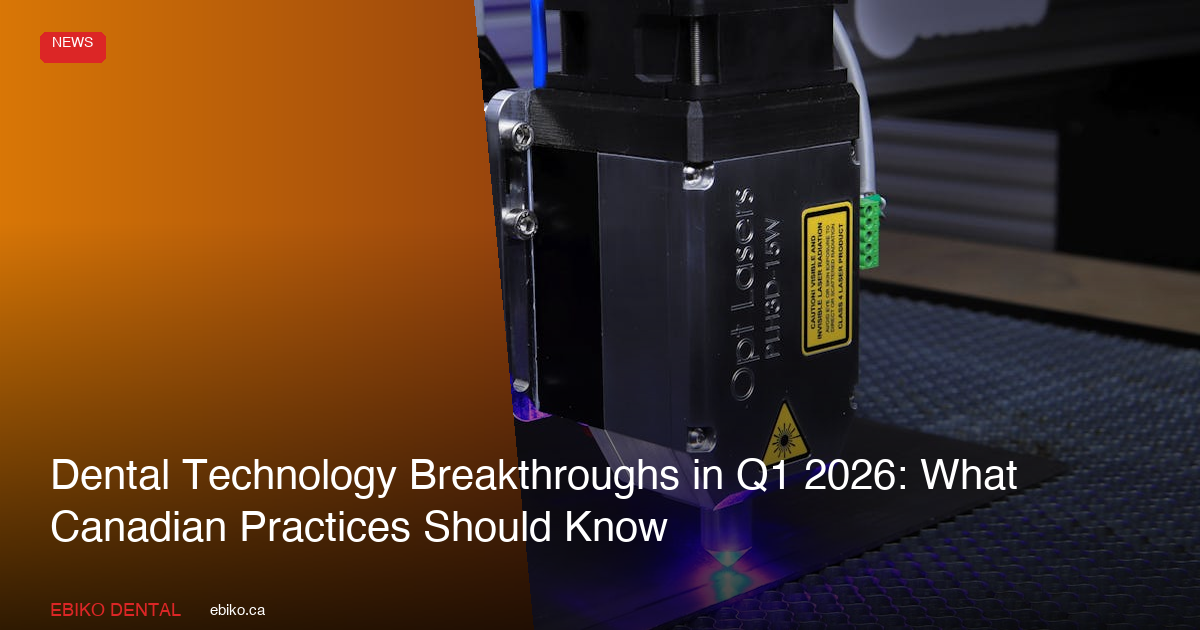
LEAP integrates a Picasso Pro diode laser, a proprietary disinfection solution, and specially engineered fibre tips into a single protocol designed to replace traditional sodium hypochlorite irrigation during root canal procedures. The system has received FDA clearance, and the manufacturer reports bacterial reduction rates exceeding 99.99 percent in clinical testing.
For Canadian endodontists and general practitioners who perform root canal therapy, the clinical implications are significant. Sodium hypochlorite, while effective as a disinfectant, carries well-documented risks including tissue damage from accidental extrusion and the characteristic taste and odour that patients dislike. A laser-based alternative that achieves comparable or superior disinfection without these drawbacks addresses both clinical safety and patient experience concerns.
Early clinical evaluation data from AMD Lasers indicates strong patient comfort outcomes, with a substantial majority of treated patients reporting no pain within 24 hours and all patients pain-free after seven days. The company also claims the protocol can reduce endodontic procedure time considerably, which has direct implications for chairside productivity and scheduling efficiency.
Pro Tip: Canadian practitioners interested in laser-assisted endodontics should confirm that any new system meets Health Canada medical device requirements before purchasing. Devices with FDA clearance do not automatically carry Health Canada authorization — verify the Medical Device Licence status through the Health Canada Medical Devices Active Licence Listing database.
First Dental-Dedicated MRI Receives Regulatory Clearance
In what may prove to be one of the most consequential imaging advances in a decade, Dentsply Sirona and Siemens Healthineers received FDA clearance for the first dental-dedicated MRI system. This is not a repurposed medical MRI — it is purpose-built for dental and maxillofacial imaging, designed to fit within a dental practice footprint and workflow.
Current dental imaging relies heavily on cone beam computed tomography (CBCT) for three-dimensional visualization. While CBCT has transformed treatment planning for implants, extractions, and orthodontics, it uses ionizing radiation. A dental MRI would provide soft tissue visualization without radiation exposure — a meaningful advantage for patients requiring repeated imaging, pediatric patients, and pregnant patients where radiation must be minimized.
The practical timeline for Canadian availability remains uncertain. Dentsply Sirona has not announced Canadian regulatory submissions, and Health Canada's medical device review process typically adds 12 to 18 months beyond FDA clearance. Additionally, the cost and space requirements for dental MRI remain unclear, which will determine whether this technology becomes practical for general practices or remains limited to specialty and hospital-based settings.
For now, the announcement signals a genuine shift in dental diagnostic capabilities. Canadian dentists should monitor Health Canada's medical device listings and the Canadian Dental Association's (CDA) technology assessment publications for updates on availability and clinical guidelines.
Bioactive Bone Graft Technology Takes a New Approach
The mid-March 2026 Dental Launch Radar highlighted OsteoGen's Bioactive Crystal Technology (BCT), a bone graft material that takes a fundamentally different manufacturing approach from conventional options. Rather than using high-temperature sintering — the standard process for most synthetic bone graft materials — BCT uses calcium phosphate crystals that retain their bioactive properties because they are never exposed to extreme heat.
This distinction matters clinically. Sintered bone graft materials can lose some of their osteoinductive potential during manufacturing. By preserving the natural crystal structure, BCT aims to deliver more predictable bone regeneration in implant site preparation, ridge augmentation, and periodontal defect repair.
For Canadian oral surgeons and periodontists, any advancement in bone graft materials is worth evaluating. The current landscape offers numerous options — autografts, allografts, xenografts, and synthetic materials — each with distinct advantages and limitations. Bioactive crystal technology adds another option to the toolkit, though long-term clinical data from Canadian patient populations will be needed to establish its place in standard protocols.
AI Integration Accelerates Across Dental Organizations
Q1 2026 saw several major announcements that collectively signal AI's transition from novelty to infrastructure in organized dentistry.
Large-Scale DSO Deployments
Aspen Dental integrated VideaHealth's Clinical Assist AI platform across its more than 1,100 practices, making it one of the largest single AI deployments in dental history. PDS Health expanded its partnership with Pearl to deploy AI-assisted imaging analysis across its network. These deployments move AI from pilot programs to standard operating procedure at scale.
For independent Canadian practices, these large-network deployments serve as proof of concept. When organizations managing hundreds or thousands of practices invest in AI imaging, it validates the technology's reliability and clinical value. It also means that patients who visit DSO-affiliated practices may begin expecting AI-assisted diagnostics as a baseline standard of care, creating competitive pressure for independent practices to evaluate similar tools.
Regulatory and Standards Developments
Orca Dental AI received FDA clearance for its AI-powered 3D orthodontic imaging system, adding to the growing list of cleared dental AI applications. The American Dental Association (ADA) called for federal investment to help small and rural practices adopt AI tools, acknowledging that the cost and complexity of implementation risk creating a technology divide between large and small practices.
In Canada, the Royal College of Dental Surgeons of Ontario (RCDSO) has not yet issued specific guidelines on AI-assisted diagnostics, but practitioners should expect guidance as these tools become more prevalent. The fundamental principle — that AI serves as a clinical decision support tool, not a replacement for professional judgment — aligns with existing RCDSO standards of practice regarding diagnostic responsibility.
Pro Tip: If you are evaluating AI diagnostic tools for your practice, prioritize systems with published peer-reviewed validation studies, not just manufacturer accuracy claims. Ask vendors for data on sensitivity and specificity rates across diverse patient populations, and confirm that the system integrates with your existing practice management software and imaging hardware.
Smart Instrument Processing: The HYDRIM 112W G4+
SciCan's launch of the HYDRIM 112W G4+ washer may not generate the same excitement as laser endodontics or dental MRI, but for practice managers and infection prevention and control (IPAC) coordinators, it addresses a persistent operational challenge. The device reports removal of 99.9 percent of protein residues under tested conditions, which directly supports compliance with RCDSO IPAC standards for instrument reprocessing.
Automated instrument washers reduce variability in the cleaning step of the reprocessing cycle — the step most susceptible to human error. For busy practices in the GTA processing hundreds of instrument sets daily, consistent, validated cleaning performance translates to reduced risk of reprocessing failures and the regulatory consequences that follow.
Ontario practices should note that the RCDSO's IPAC guidelines require that all reusable dental instruments undergo thorough cleaning before sterilization, and that cleaning processes should be validated and documented. Automated washers with built-in cycle tracking and data logging capabilities simplify this documentation requirement and provide an audit trail for regulatory inspections.
Health Information Exchange Integration for Dental
CareQuest Innovation Partners' partnership with Kno2 to advance dental integration into health information exchange (HIE) infrastructure may be the least flashy announcement of Q1 2026, but it addresses one of dentistry's most persistent systemic problems: isolation from the broader healthcare record.
In Canada, efforts to integrate dental records into provincial health information systems have been slow. Ontario's electronic health record infrastructure through Ontario Health does not routinely include dental records, meaning that a patient's physician may have no visibility into their dental health status and vice versa. This disconnect has direct clinical consequences — periodontal disease is linked to cardiovascular disease, diabetes management, and adverse pregnancy outcomes, yet dental findings rarely inform medical treatment decisions.
While HIE integration is further along in the United States, the Canadian dental community should watch these developments closely. As provincial digital health strategies evolve, dental practices that adopt interoperable electronic health record systems will be better positioned for eventual integration requirements.
Virtual Reality Training Enters Dental Education
The opening of the first virtual reality lab for dental hygiene students at the Community College of Baltimore County points to a broader shift in dental education methodology. VR simulation allows students to practise procedures in a risk-free environment before working on live patients, potentially accelerating skill development and improving clinical confidence.
Canadian dental schools, including the University of Toronto Faculty of Dentistry and the Schulich School of Medicine and Dentistry at Western University, have been exploring simulation-based training for several years. As VR hardware costs decrease and dental-specific simulation software matures, expect wider adoption across Canadian dental and dental hygiene programs.
For practising dentists in Toronto and the GTA, VR training is also emerging as a continuing education tool. Hands-on CE courses increasingly incorporate simulation elements, allowing practitioners to practise new techniques — particularly in implant placement and surgical procedures — before applying them clinically.
What These Innovations Mean for Canadian Practices
The common thread across these Q1 2026 developments is convergence: imaging, diagnostics, treatment delivery, instrument processing, and record-keeping are all becoming more integrated, more automated, and more data-driven. For Canadian dental professionals, the practical implications include continued investment in digital infrastructure, attention to Health Canada regulatory timelines for new technologies, and a willingness to evaluate — though not necessarily adopt immediately — tools that demonstrably improve clinical outcomes or operational efficiency.
EBIKO Dental will continue monitoring these technology developments and their availability in the Canadian market.
Frequently Asked Questions
Q: When will the LEAP laser root canal system be available in Canada?
The LEAP system received FDA clearance and was formally introduced at the AAE Annual Meeting in April 2026. Canadian availability depends on Health Canada medical device authorization, which typically takes 12 to 18 months after FDA clearance. Canadian dentists should monitor the Health Canada Medical Devices Active Licence Listing for updates on authorization status.
Q: Is AI-assisted dental imaging approved for use in Ontario dental practices?
AI diagnostic tools that have received Health Canada authorization as medical devices can be used in Ontario dental practices. The Royal College of Dental Surgeons of Ontario (RCDSO) has not issued specific restrictions on AI-assisted imaging, though practitioners retain full diagnostic responsibility regardless of AI support. Any AI tool used clinically must be registered as a medical device with Health Canada.
Q: How does dental-dedicated MRI differ from standard medical MRI for dental imaging?
Dental-dedicated MRI systems are purpose-built for maxillofacial imaging with a smaller footprint, faster scan times, and protocols optimized for dental structures. Unlike CBCT, dental MRI uses no ionizing radiation and provides superior soft tissue visualization. The first such system, developed by Dentsply Sirona and Siemens Healthineers, received FDA clearance in Q1 2026, though Canadian availability has not yet been announced.