
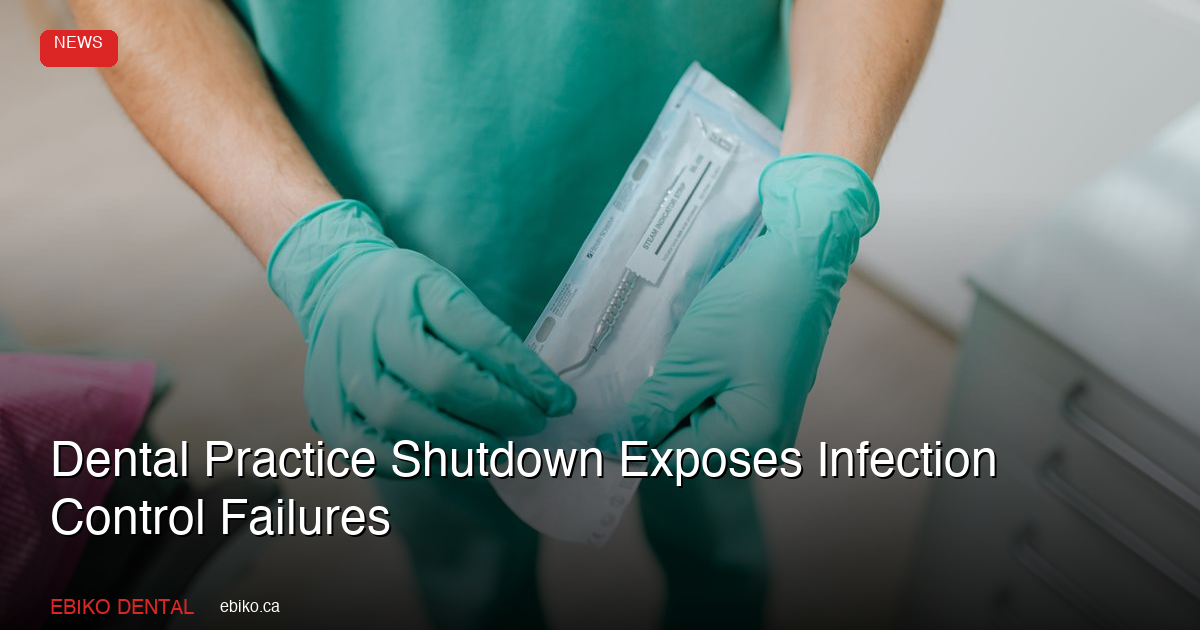
A Philadelphia dental office was shut down in May 2026 after health authorities found systematic infection control failures including reuse of single-patient items, putting over a year of patients at risk of hepatitis and HIV exposure. Here is what went wrong, how Canadian regulations differ, and what every Ontario practice should audit right now.
As of June 2026, the dental profession is confronting one of the most significant infection control incidents in recent memory. The Philadelphia Department of Public Health issued an urgent advisory recommending that patients who visited Smiles at Rittenhouse Square between April 2025 and May 2026 be tested for hepatitis B, hepatitis C, and HIV. The Pennsylvania State Board of Dentistry suspended the practitioner's licence on May 15, 2026, citing "a clear and immediate danger to public health and safety."
For dental professionals in Toronto, the Greater Toronto Area, and across Ontario, this incident is not a distant headline — it is a sobering reminder that infection prevention and control (IPAC) protocols exist for precise, life-saving reasons.
What Happened at the Philadelphia Practice
According to the Philadelphia Department of Public Health and ABC News reporting, investigators documented several critical failures at the Rittenhouse Square dental office:
- Reuse of single-use anesthetic vials: Injectable medication vials intended for one patient were set aside and reused on subsequent patients, creating a direct pathway for bloodborne pathogen transmission.
- Reuse of IV saline bags: Intravenous saline bags designated for single-patient use were shared between patients.
- Improper instrument sterilization: Equipment exposed to blood and saliva was not sterilized according to established protocols between patients.
- Inadequate compliance monitoring: The practice lacked documentation of routine sterilization cycle verification.
No confirmed transmissions of hepatitis or HIV have been reported as of this writing. However, the exposure window of over thirteen months means hundreds of patients may require testing — and the psychological harm of that uncertainty should not be underestimated.
How Canadian IPAC Standards Address These Risks
Canadian dental practices operate under a regulatory framework that explicitly addresses each of the failures identified in Philadelphia. The Royal College of Dental Surgeons of Ontario (RCDSO) mandates compliance with IPAC standards that align with Public Health Ontario (PHO) and Health Canada guidelines.
Pro Tip: The RCDSO's Infection Prevention and Control in the Dental Office guideline is not optional reading — it is a regulatory obligation. If your copy is from before 2024, download the current version from the RCDSO website immediately.
Single-Use Items Are Non-Negotiable
Under Ontario regulations, any item labelled for single use must be discarded after one patient. This includes anesthetic carpules, syringes, saliva ejectors, prophy angles, and irrigation solutions. The RCDSO standard is unambiguous: reprocessing single-use devices is a violation regardless of whether the item "looks clean" or has remaining product.
Sterilization Monitoring Must Be Documented
Ontario dental practices are required to perform and record mechanical, chemical, and biological monitoring for every sterilization cycle. As of January 2026, compliance requirements have been reinforced: mechanical indicators (checking autoclave temperature, pressure, and time), chemical indicators (internal and external process indicators in every package), and biological indicators (spore testing at minimum weekly, with results documented) must all be in place.
Pro Tip: If your practice does not have a dedicated IPAC logbook — physical or digital — that tracks every sterilization cycle with date, time, operator initials, and indicator results, you have a documentation gap that could become a regulatory issue.
Instrument Reprocessing Follows a Fixed Sequence
The standard reprocessing sequence mandated by PHO and reinforced by the RCDSO follows a specific workflow: point-of-use treatment (pre-soaking or wiping to prevent bioburden from drying), transport in a covered, puncture-resistant container, cleaning (manual scrub or ultrasonic cleaner followed by rinsing), inspection for visible debris, packaging in sterilization pouches or cassettes, sterilization in an autoclave with monitoring, and storage in a clean, dry, designated area.
Skipping any step — particularly cleaning before sterilization — compromises the entire chain. Autoclaving a contaminated instrument that was not properly cleaned first does not guarantee sterility.
What Ontario Practices Should Audit Now
The Philadelphia case should prompt every dental practice in the GTA and across Ontario to conduct a focused IPAC self-audit. Here is a practical checklist:
Immediate Actions
- Single-use item inventory: Walk through each operatory and confirm that no single-use items are being set aside for reuse. Check anesthetic carpules, irrigation syringes, saliva ejectors, and prophy cups.
- Sterilization log review: Pull the last 30 days of sterilization records. Are mechanical, chemical, and biological indicator results documented for every cycle? Are there gaps?
- Staff training verification: When was the last IPAC training session for all clinical staff, including part-time hygienists and dental assistants? Ontario best practice recommends annual refresher training at minimum.
- Autoclave maintenance records: Is your autoclave serviced according to the manufacturer's schedule? Are service records on file?
Longer-Term Improvements
- Written IPAC manual: Your practice should have a written, dated IPAC manual that is reviewed and updated annually. This document should be accessible to all clinical staff.
- Designated IPAC lead: Assign one team member as the practice's IPAC coordinator responsible for monitoring compliance, updating protocols, and managing sterilization records.
- Patient-facing transparency: Consider posting your IPAC commitment in your waiting area or on your website. Patients increasingly ask about sterilization practices, and proactive transparency builds trust.
Pro Tip: Schedule a 15-minute IPAC spot-check during your next team huddle. Have each clinical staff member walk through the instrument reprocessing sequence verbally. Gaps in understanding often reveal gaps in practice.
The Regulatory Consequences in Canada
In Ontario, IPAC violations carry significant consequences. The RCDSO can investigate complaints, conduct practice inspections, and impose sanctions ranging from mandatory remedial training to licence suspension or revocation. Public Health Ontario can issue orders requiring practice closure and patient notification if a genuine exposure risk is identified.
Beyond regulatory action, the reputational and financial impact of an IPAC breach is severe. The Philadelphia practice is now permanently closed. The practitioner's career is effectively over. The human cost — patients living with uncertainty about their bloodborne pathogen status — is incalculable.
Frequently Asked Questions
Q: Are Canadian dental practices subject to random IPAC inspections?
Ontario dental practices can be inspected by the RCDSO as part of the Quality Assurance program or in response to a complaint. Public Health Ontario can also conduct inspections related to infection control. Practices should always be inspection-ready rather than preparing only when notified.
Q: How often should biological indicator (spore) testing be done on dental autoclaves?
The RCDSO and Public Health Ontario recommend biological indicator testing at minimum once per week, and after every autoclave repair or malfunction. Results must be documented and retained. If a spore test fails, all items processed since the last passing test should be considered non-sterile.
Q: What should a dental practice do if an IPAC breach is discovered internally?
Immediately stop using the affected equipment or process, document the breach in detail, assess the scope of potential patient exposure, consult with the RCDSO and local public health unit for guidance on notification obligations, and implement corrective measures before resuming the process. Attempting to address a breach quietly without proper reporting can escalate the regulatory consequences significantly.
EBIKO Dental will continue monitoring developments in this case and reporting on IPAC compliance updates relevant to Canadian dental practices. For questions about infection control supplies and sterilization products available through EBIKO Dental, visit our website or contact our team.