
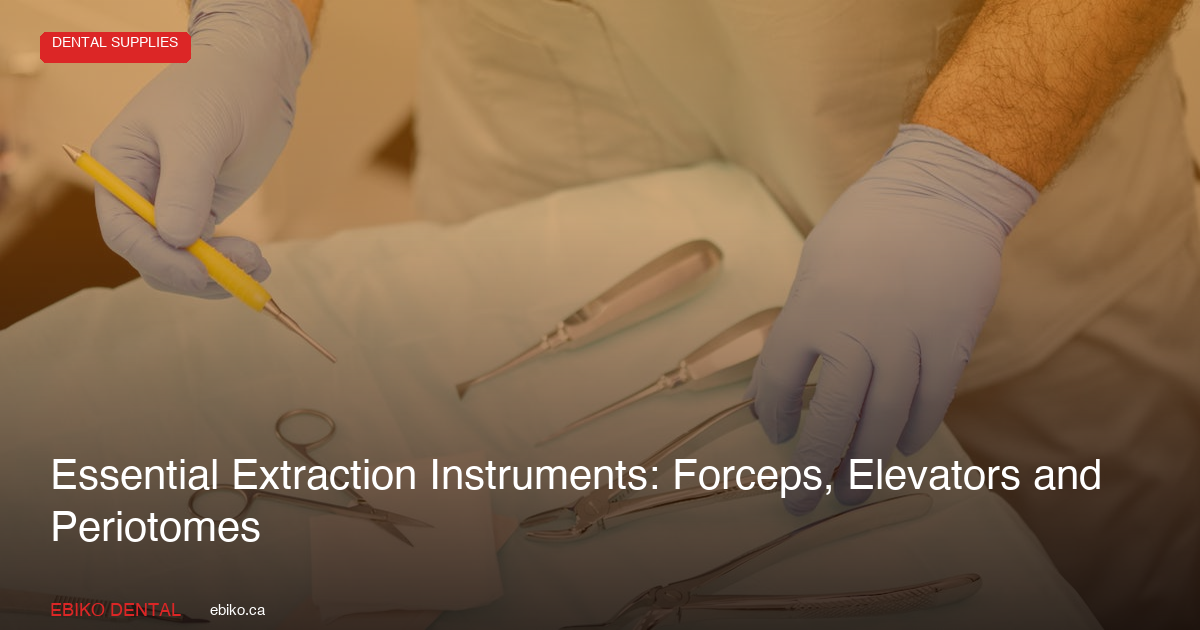
Choosing the right extraction forceps, elevators, and periotomes directly impacts patient outcomes, procedure time, and tissue preservation. This guide breaks down the three instrument categories every Canadian dental practice needs, explains when to use each type, and highlights EBIKO Dental's Kumani and Atraumair lines — purpose-built for efficient, atraumatic extractions.
As of March 2026, dental extraction remains one of the most commonly performed surgical procedures in Canadian dental practices. Whether you are managing a routine anterior extraction in a family practice in Toronto or tackling an impacted third molar in a surgical suite in Mississauga, the instruments you choose determine your control, your efficiency, and your patient's recovery trajectory.
Yet many practices across the GTA are still working with a limited forceps selection — often a handful of patterns inherited from a previous owner or purchased as a starter kit years ago. A well-curated extraction instrument tray is not a luxury. It is a clinical necessity that reduces complication rates, shortens chair time, and improves patient satisfaction.
The Three Pillars of Extraction Instrumentation
Every extraction follows a predictable sequence: sever the periodontal ligament, luxate and mobilize the tooth, and deliver it from the socket. Each step requires a distinct instrument category. Understanding the interplay between periotomes, elevators, and forceps allows you to select the right tool at the right moment — reducing force, preserving bone, and minimizing soft tissue trauma.
Periotomes: The First Move in Atraumatic Extraction
Periotomes are thin, sharp instruments designed to sever the periodontal ligament fibres before any luxation force is applied. By cleanly cutting the PDL attachment around the circumference of the root, periotomes reduce the amount of force required during subsequent elevator and forceps use. For practices focused on implant placement — and in the GTA, that is an increasing share — preserving the buccal plate is non-negotiable. Periotomes make that possible.
EBIKO Dental offers both standard and premium periotome options. The Posterior Periotome provides reliable PDL severance with a blade geometry designed for posterior access. For practices that prefer enhanced grip and aesthetics, the Siyah Posterior Periotome features EBIKO's Siyah series matte black finish — not just visually distinctive, but designed to reduce light reflection under the operatory lamp. The Serrated Siyah Posterior Periotome adds micro-serrations along the blade edge for improved grip in the PDL space, particularly useful when dealing with fibrotic or calcified ligament attachments in older patients.
Pro Tip: Insert your periotome into the sulcus and work around the entire tooth circumference before reaching for an elevator. Spending an extra 60-90 seconds on thorough PDL severance can reduce your total extraction time by 2-3 minutes and dramatically decrease the risk of root tip fracture.
Elevators: Controlled Luxation and Mobilization
Once the PDL is severed, elevators expand the socket and mobilize the tooth using controlled wedging and rotational forces. The elevator is arguably the most important instrument in your extraction tray — a well-placed elevator can make forceps delivery almost effortless.
Straight Elevators
Straight elevators are your workhorse instruments, used for initial luxation on nearly every extraction. They work by wedging between the tooth root and alveolar bone, applying controlled apical and rotational pressure. EBIKO Dental's Heidbrink Elevator, Straight is a classic pattern with a narrow blade ideal for anterior and premolar teeth. The Bernard Elevator, Straight offers a slightly different blade profile suited for wider interdental spaces.
For practices that invest in the Siyah series, the Siyah Bernard Syndesmotome Elevator combines the syndesmotome function (PDL severance) with elevator luxation in a single instrument — a time-saver when workflow efficiency matters.
Specialty Elevators
Third molar extractions demand specialty elevator patterns. The Stout Elevator for 3rd Molars and the 11A Stout Elevator are specifically designed with wider, sturdier blades that can withstand the higher forces required for impacted or partially erupted wisdom teeth. EBIKO also carries the Bein Elevator, Large — a heavier-duty option for root tip retrieval and challenging mandibular extractions.
The 11LX Elevator with Winter Cross-Bar Handle and its right-sided counterpart, the 11RX Elevator, offer superior torque control through their T-bar handle design. These are particularly valuable for left and right mandibular third molar work where standard handle designs can limit wrist positioning.
The MacMillan Gouge Elevator rounds out the specialty category — designed for bone removal around impacted teeth, it functions as both an elevator and a gouge, reducing instrument changes during complex surgical extractions.
Extraction Forceps: Controlled Delivery
Forceps are the final step — they grasp the tooth and deliver it from the socket after adequate luxation. Choosing the correct forceps pattern for each tooth type reduces the risk of root fracture, crown fracture, and adjacent tooth damage. EBIKO Dental carries two distinct forceps lines, each with a specific clinical philosophy.
The Kumani Forceps Line
EBIKO's Kumani series is a comprehensive extraction forceps system covering every tooth position. The Kumani design philosophy emphasizes ergonomic handles and anatomically contoured beaks for maximum grip with minimum force.
Upper Anteriors: The #1 Upper Anterior Kumani Forceps handles routine upper incisor and canine extractions. For roots with less coronal structure to grip, the #1 Upper Anterior Apical Kumani Forceps features narrower, more apically-angled beaks that can grip below the CEJ.
Upper Universals: The #150 Upper Universal Apical Kumani Forceps is the go-to pattern for upper premolars and any upper tooth where root morphology is uncertain. Its versatile beak design adapts to multiple tooth shapes.
Upper Molars: The #53L Upper Molar Kumani Forcep and #53R Upper Molar Kumani Forceps are side-specific patterns with beak geometry that engages the buccal bifurcation of upper molars — left and right variants ensure optimal access on both sides of the arch. The #88L Nevius Upper Molar Kumani Forceps and #88R Nevius Upper Molar Kumani Forceps offer an alternative molar pattern preferred by practitioners who favour the Nevius beak design for molar furcation engagement.
Lower Teeth: The #151 Lower Universal Kumani Forceps covers lower premolars and anteriors, while the #151 Lower Universal Apical Kumani Forceps adds apical reach for compromised crowns. For lower molars, the #222 Lower Molars Kumani Forceps and its apical variant, the #222 Lower Molars Apical Kumani Forceps, provide the beak width and angulation needed for mandibular molar roots.
The #23 Cowhorn Kumani Forceps deserves special mention — the cowhorn pattern is designed to engage the furcation of lower molars, allowing the tooth to be "walked out" with a rocking motion. It is one of the most efficient forceps patterns for lower molar extraction when furcation access is available.
For root tip retrieval, the #69 Tomes Upper & Lower Roots Kumani Forceps provides the fine-tipped beak design needed to grasp fractured root fragments without additional bone removal.
Pro Tip: Build your Kumani forceps tray in stages. Start with the five most-used patterns — #150 Upper Universal, #151 Lower Universal, #53L and #53R Upper Molars, and #222 Lower Molars — then add specialty patterns as your surgical volume grows.
The Atraumair Forceps Line
EBIKO's Atraumair series represents a more specialized approach to extraction. Designed for atraumatic technique, these forceps prioritize tissue and bone preservation — making them the instrument of choice when implant placement will follow extraction.
The Upper Incisors Atraumair Extraction Forceps and its apical variant, the Apical Upper Incisors Atraumair Forceps, feature slim beak profiles that minimize buccal plate compression during delivery. The Diamond Dusted versions — the Upper Incisors Atraumair Diamond Dusted Forceps and the Apical Upper Incisors Atraumair Diamond Dusted Forceps — add a micro-abrasive diamond coating to the inner beak surface. This coating dramatically improves grip on wet, blood-covered root surfaces without requiring increased compressive force.
The Serrated Upper Anteriors Extraction Forceps and the 101 Hull Upper & Lower Premolars Universal Extraction Forceps round out the standard extraction forceps collection for routine cases.
Building Your Extraction Instrument Tray: A Practical Guide
For a general dental practice in Ontario handling routine extractions, here is a recommended tray setup using EBIKO Dental instruments:
- PDL Severance: 1 Posterior Periotome + 1 Serrated Siyah Posterior Periotome
- Luxation: Heidbrink Straight Elevator + Bernard Straight Elevator + 1 pair Winter Cross-Bar Elevators (11LX + 11RX)
- Upper Delivery: #150 Upper Universal Kumani + #53L and #53R Upper Molar Kumani
- Lower Delivery: #151 Lower Universal Kumani + #222 Lower Molars Kumani + #23 Cowhorn Kumani
- Root Tips: #69 Tomes Kumani
This 11-instrument tray covers the vast majority of extraction scenarios you will encounter in a general practice setting. Oral surgery-focused practices should add the Stout elevators, Bein elevator, and the full Atraumair line for implant-site extractions.
Instrument Care and Infection Prevention
The Royal College of Dental Surgeons of Ontario (RCDSO) requires that all reusable surgical instruments undergo sterilization between patients using a validated steam autoclave cycle. For extraction instruments specifically:
- Inspect elevator tips and forceps beaks for wear, chipping, or deformation before each use
- Replace any instrument with a compromised working end immediately — a dull elevator tip increases the force required and the risk of slippage
- Use cassette-based sterilization systems to keep extraction trays organized and reduce handling errors
- Document sterilization cycle monitoring results as required by Health Canada and provincial infection prevention and control (IPAC) standards
Pro Tip: Rotate two identical extraction trays so one is always sterile and ready while the other is in processing. For practices in busy GTA clinics performing 5 or more extractions per day, this rotation eliminates wait times between surgical cases.
Frequently Asked Questions
Q: What is the difference between Kumani and Atraumair forceps from EBIKO Dental?
Kumani forceps are a comprehensive general-purpose extraction line designed for efficient delivery across all tooth types. Atraumair forceps are specifically engineered for atraumatic extraction with slim beak profiles and optional diamond-dusted grip surfaces — ideal when bone preservation is critical for subsequent implant placement. Many practices stock both lines to match the instrument to the clinical situation.
Q: How often should dental extraction instruments be replaced?
Inspect extraction instruments visually before each use and perform a detailed assessment quarterly. Replace elevators when blade tips show rounding or chipping, and forceps when beak alignment drifts or serrations flatten. Most high-quality stainless steel instruments last 3-5 years with proper care, but high-volume practices may replace more frequently. EBIKO Dental instruments are manufactured from surgical-grade stainless steel for extended service life.
Q: Does EBIKO Dental ship extraction instruments across Canada?
Yes. EBIKO Dental offers free shipping on orders over $99 CAD within the GTA, $199 CAD across Ontario, and $299 CAD Canada-wide. All instruments come with a price match guarantee. Shop the full extraction instrument collection at EBIKO Dental.
Shop extraction forceps, elevators, and periotomes at EBIKO Dental — your Canadian source for quality dental instruments with fast GTA delivery.