
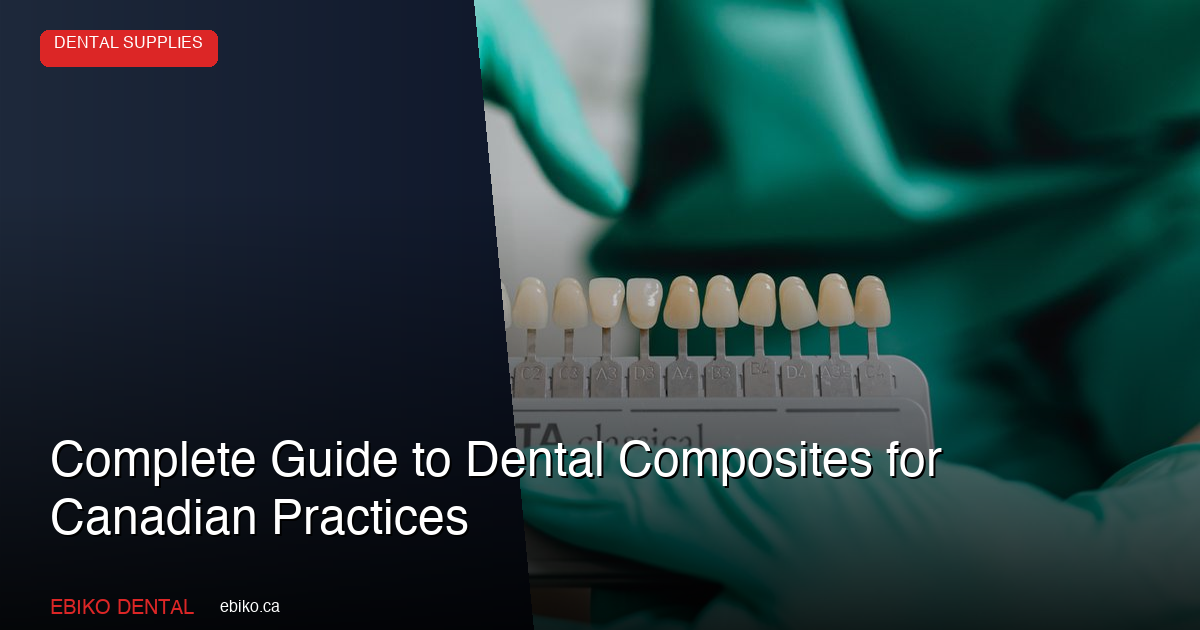
Choosing the right dental composite involves balancing handling characteristics, shade matching, polymerization shrinkage, and clinical indication. This guide breaks down the major composite categories — nanohybrid, bulk-fill, flowable, and universal — and helps Canadian dental professionals select the right material for every restoration, with product options available through EBIKO Dental.
As of June 2026, dental composites have become the dominant direct restorative material in Canadian practices. Amalgam use continues to decline as Health Canada aligns with the World Health Organization's mercury phase-down initiative, and patient demand for tooth-coloured restorations grows steadily. For dental professionals in Toronto, the GTA, and across Ontario, understanding the differences between composite categories is essential for clinical success and efficient inventory management.
This guide covers the composite types most commonly used in Canadian general practices, with practical selection guidance and product recommendations from the EBIKO Dental catalogue.
Understanding Dental Composite Categories
Modern dental composites share a basic structure: a resin matrix (typically Bis-GMA, UDMA, or TEGDMA), inorganic filler particles (glass, silica, or zirconia), and a coupling agent that bonds filler to matrix. What differentiates composite categories is primarily filler particle size, filler loading percentage, and resin chemistry modifications.
Nanohybrid and Universal Composites
Nanohybrid composites combine nano-sized filler particles (typically 20–75 nm) with conventional micro-sized particles (0.4–5 μm). This blend delivers a balance of strength, polishability, and handling that makes nanohybrid composites the workhorse of most restorative practices.
Clinical indications: Class I through Class V restorations, anterior and posterior. Suitable for direct veneers, diastema closures, and core build-ups when combined with appropriate bonding protocols.
Key characteristics:
- High filler loading (typically 75–85% by weight) provides strength and wear resistance suitable for posterior occlusal surfaces.
- Good polishability from nano-scale particles produces a smooth, enamel-like surface finish.
- Available in extensive shade systems (Vita-based and proprietary) for predictable colour matching.
- Standard 2 mm incremental placement with light curing of 20–40 seconds per increment.
Products like the 3M Filtek Z250 Composite Compules (20/Pk) represent the nanohybrid category well. The Z250 has been a clinical benchmark for posterior restorations for years, offering reliable handling, low shrinkage relative to its generation, and a well-validated shade system that most Canadian clinicians know well.
For practices looking for a more modern nanofilled option, the Dentsply Esthet-X HD Compules (20/Pk) offers enhanced esthetics with a micro-matrix technology that delivers chameleon-like blending — useful in anterior restorations where shade transition across the restoration margin matters.
Universal Chromatic Composites
A significant innovation in composite technology is the universal chromatic composite, exemplified by the Tokuyama OMNICHROMA system. These composites use structural colour technology rather than traditional pigments: uniformly sized supra-nano spherical fillers generate structural colour that adapts to the surrounding tooth structure.
The practical benefit is dramatic: one shade covers the entire Vita range (A1 to D4), eliminating the need for shade-matching procedures and reducing inventory to a single composite syringe or compule type.
EBIKO Dental carries the Tokuyama OMNICHROMA BULK FLOW Syringe (3g), which combines the universal shade-matching technology with bulk-fill flowable properties — a two-in-one solution that simplifies both shade selection and placement technique.
Pro Tip: Universal chromatic composites are particularly valuable for practices with high patient volume where chair time efficiency matters. Eliminating the shade-selection step saves 2–5 minutes per restoration, which compounds across a full day of restorative appointments.
Bulk-Fill Composites
Bulk-fill composites are engineered to be placed in increments of 4–5 mm rather than the standard 2 mm, reducing the number of placement and curing cycles per restoration. This is achieved through modified photoinitiator systems that increase depth of cure and resin chemistries that reduce polymerization shrinkage stress.
Clinical indications: Class I and Class II posterior restorations where depth allows for reduced incremental layering. Particularly efficient for deep box preparations in premolars and molars.
Key characteristics:
- 4–5 mm depth of cure per increment (compared to 2 mm for conventional composites).
- Reduced polymerization shrinkage stress through modified monomer chemistry.
- Available in sculptable (packable) and flowable consistencies.
- Some products require a capping layer of conventional composite for occlusal surface wear resistance; others are designed as full-depth, single-material restorations.
The Kerr SonicFill 3 Bulk-Fill Sonic-Activated Composite (20-Capsule Refill) represents a unique approach within the bulk-fill category. The SonicFill system uses sonic energy delivered through a dedicated handpiece to temporarily reduce the composite's viscosity during placement, allowing it to flow and adapt to cavity walls. Once the sonic energy stops, the material returns to a packable consistency for sculpting. This eliminates the need for a separate flowable liner in most preparations.
Pro Tip: When switching from conventional incremental placement to bulk-fill technique, ensure your curing light output is verified at 1,000 mW/cm² or higher. Bulk-fill composites depend on adequate light energy reaching the full depth of the increment — an underperforming curing light will compromise the cure at depth regardless of the composite's claimed specifications.
Flowable Composites
Flowable composites have a lower filler loading (typically 55–65% by weight) and higher resin content than packable composites, giving them a thin, injectable consistency. They serve specific clinical roles where adaptation to irregular cavity geometry is important.
Clinical indications:
- Cavity liner under packable composites to improve adaptation and reduce voids at the cavity floor.
- Small Class V cervical restorations where the thin, flexible material accommodates tooth flexure.
- Minimally invasive Class I restorations in pits and fissures.
- Repair of small marginal defects in existing restorations.
The Danville StarFlow Flowable Composite Syringe (5g) available through EBIKO Dental provides good handling with a controlled flow that does not slump on inclined surfaces — a common complaint with overly fluid flowables.
For practices that want bulk-fill efficiency combined with flowable handling, the Tokuyama OMNICHROMA BULK FLOW mentioned earlier bridges both categories with its 4 mm depth of cure and self-levelling consistency.
Composite Selection by Clinical Scenario
Rather than choosing a single composite for all situations, most efficient Canadian practices maintain a focused inventory of three to four composites that cover the full range of clinical needs:
- Posterior Class I and II (routine): Bulk-fill composite for efficient, deep restorations. Kerr SonicFill 3 or a sculptable bulk-fill product.
- Posterior Class I and II (esthetic priority): Nanohybrid composite like 3M Filtek Z250 or Dentsply Esthet-X HD for superior polishability and shade matching.
- Anterior Class III, IV, and direct veneers: Nanohybrid or nanofilled composite with a comprehensive shade system. Esthet-X HD or a dedicated anterior composite.
- Class V and small repairs: Flowable composite like Danville StarFlow for adaptation to irregular margins and cervical flexure zones.
- High-volume practices seeking simplification: Universal chromatic composite (Tokuyama OMNICHROMA system) to reduce shade inventory and selection time.
Pro Tip: Audit your composite inventory quarterly. Many practices carry six to eight composite lines accumulated over years of trying new products. Consolidating to three to four core products reduces waste from expired materials, simplifies staff training, and often qualifies for better volume pricing from your supplier.
Bonding Agents: The Foundation of Composite Success
No composite restoration performs well without a reliable bonding protocol. EBIKO Dental carries bonding agents and etching gels that pair with any composite system:
- Pulpdent ETCH-RITE 38% Phosphoric Acid Etching Gel (24 Syringes) — A selective-etch or total-etch system foundation. The 38% concentration provides reliable enamel etching in 15 seconds with a thixotropic gel that stays where you place it.
Whether you use a total-etch, selective-etch, or self-etch bonding protocol depends on your clinical situation and bonding agent choice. The critical point is consistency: pick a protocol, train your team on it, and follow it the same way every time. Most bonding failures trace back to protocol deviations (contamination with saliva or blood, insufficient etch time, over-drying dentin) rather than product limitations.
Storage and Handling Best Practices
Composite material performance depends on proper storage:
- Temperature: Store composites between 2°C and 28°C. Avoid leaving syringes or compules in direct sunlight or near autoclaves where ambient heat can exceed recommended ranges.
- Light protection: Composites are light-activated. Keep them in opaque containers or their original packaging until the moment of use. Leaving an uncapped syringe under operatory lighting prematurely initiates polymerization.
- Expiry monitoring: Implement a first-in, first-out rotation system. Expired composites may have altered handling characteristics and compromised mechanical properties.
Frequently Asked Questions
Q: Can bulk-fill composites completely replace conventional layered composites in a Canadian practice?
For posterior restorations, bulk-fill composites handle the majority of clinical scenarios efficiently. However, for anterior restorations requiring layered shade effects (translucency, opacity, characterization), conventional nanohybrid composites with multiple shade options remain superior. Most practices benefit from carrying both categories.
Q: How does the Tokuyama OMNICHROMA single-shade system handle highly characterised teeth?
OMNICHROMA excels at matching standard shade ranges from A1 through D4. For highly characterised teeth with significant internal colour variation, banding, or extreme translucency requirements, a multi-shade nanohybrid system may still be necessary for the most demanding anterior esthetic cases. For posterior restorations and routine anterior work, OMNICHROMA's structural colour technology matches reliably.
Q: What is the shelf life of dental composites, and how should Canadian practices manage inventory?
Most dental composites have a shelf life of two to three years from the date of manufacture when stored according to the manufacturer's recommendations. Practices should check expiry dates monthly, maintain a first-in-first-out rotation system, and consolidate orders to avoid carrying excessive stock that risks expiring before use. EBIKO Dental offers competitive pricing on composite products, with free shipping on orders over $99 CAD in the GTA, $199 CAD across Ontario, and $299 CAD Canada-wide.
Shop dental composites and restorative supplies at EBIKO Dental — your Canadian source for clinical-grade materials with price match guarantee and fast GTA delivery.