
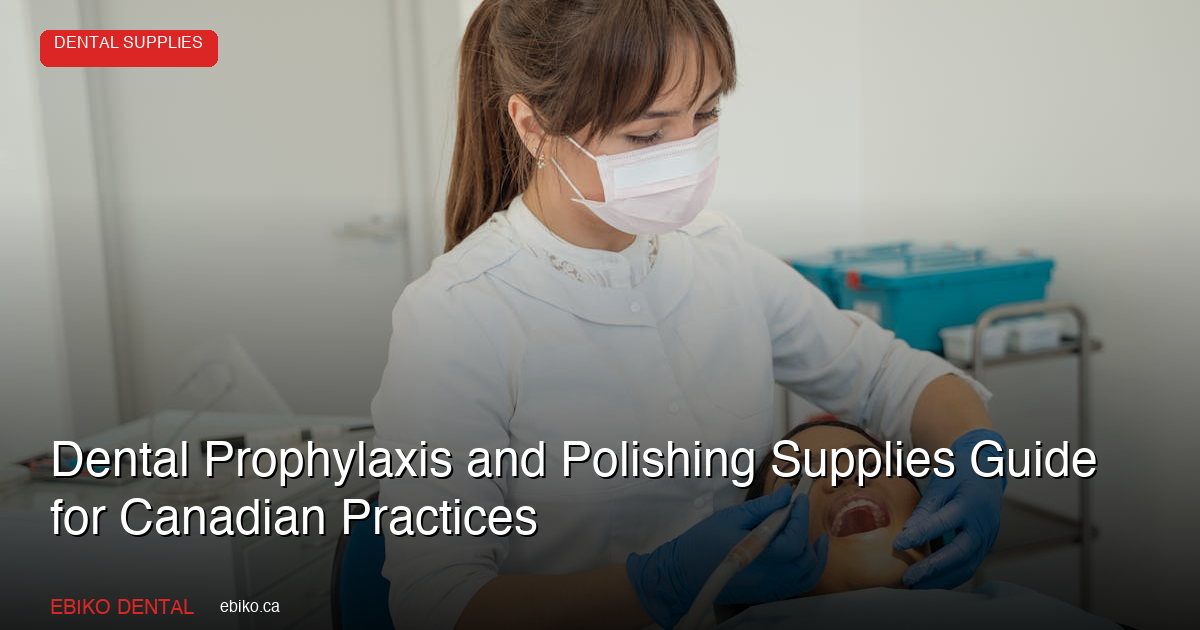
Professional prophylaxis is the backbone of preventive dentistry, and your choice of prophy paste, polishing system, and fluoride varnish directly impacts patient outcomes, workflow efficiency, and supply costs. This guide covers the full range of dental prophylaxis and polishing supplies available at EBIKO Dental — from coarse pastes for heavy stain removal to fine polishing discs for composite finishing — with selection guidance tailored to Canadian clinical practice.
As of May 2026, preventive care visits account for approximately 60% of appointments at most Canadian dental practices. The hygiene operatory drives a significant portion of practice revenue while building the patient relationships that lead to restorative and cosmetic treatment acceptance. Yet many practices default to a single prophy paste and a standard polishing cup without considering how strategic supply selection can improve outcomes and efficiency. Practices in Toronto, Mississauga, Markham, and across the Greater Toronto Area benefit from understanding the full spectrum of prophylaxis options available from Canadian suppliers.
Understanding Prophy Paste Formulations
Prophy paste serves two functions: mechanical stain and biofilm removal, and surface preparation for fluoride uptake. The formulation you choose affects cleaning efficacy, enamel surface roughness, splatter control, and patient comfort.
Grit Selection and Clinical Application
- Coarse grit: Reserved for heavy extrinsic stain removal (coffee, tobacco, chlorhexidine staining). Use only on enamel surfaces with visible staining. Not appropriate for exposed dentin, cementum, or restorative materials.
- Medium grit: The workhorse for routine adult prophylaxis. Effective against moderate staining while maintaining acceptable surface smoothness. Appropriate for most recall patients.
- Fine grit: Ideal for pediatric patients, sensitive teeth, recently whitened enamel, and patients with minimal staining. Produces the smoothest post-polish surface.
The Denti Polish Prophy Paste (Medium Mint, 12oz Jar) delivers consistent medium-grit performance for routine adult prophylaxis. The 12-ounce jar format reduces per-unit costs compared to single-use cups for high-volume practices.
Pro Tip: Stock at least two grit levels in each operatory. Having medium and fine on hand eliminates the workflow interruption of leaving the room to retrieve a different paste when a patient presents with less staining than expected.
Unit-Dose vs. Jar Format: A Workflow Decision
The choice between unit-dose cups and bulk jars involves trade-offs in infection control compliance, cost efficiency, and ergonomics:
Unit-Dose Cups
Single-patient cups eliminate cross-contamination risk entirely. The DentiCare Pro-Polish Prophylaxis Paste (200/Box) provides pre-portioned cups that are discarded after each patient — no scooping from shared containers, no contamination concerns during provincial health inspections.
The Dentsply Nupro Prophy Paste Unit-Dose Cups (200/Box) is the industry-standard unit-dose option, offering consistent performance with the splatter-free formulation that hygienists favour for maintaining a clean field.
Bulk Jar Format
Jar-format pastes like the Denti Polish 12oz Jar offer lower per-application costs and reduce packaging waste. When using jars, the Royal College of Dental Surgeons of Ontario (RCDSO) infection prevention and control (IPAC) standards require single-use disposable dappen dishes for portioning — never insert a contaminated prophy cup back into the jar.
Prophy Angles: Disposable vs. Autoclavable
Modern infection control standards strongly favour disposable prophy angles for routine prophylaxis. The Disposable Prophy Angle (100/pk) available at EBIKO Dental comes in two styles — firm cup and soft cup — to accommodate clinician preference and patient sensitivity.
Advantages of disposable angles:
- Zero reprocessing labour cost (no scrubbing, packaging, autoclaving)
- Consistent cup flexibility — no degradation from repeated sterilization cycles
- Simplified IPAC compliance documentation
- Available in latex-free formulations for allergic patients
At current pricing, the labour cost of reprocessing a reusable angle (approximately $2.50 to $3.50 CAD in staff time and sterilization consumables) exceeds the per-unit cost of most quality disposable options.
Polishing Systems for Restorative Finishing
Beyond routine prophylaxis, composite restorations require specific polishing sequences to achieve optimal surface smoothness, colour stability, and plaque resistance. Inadequately polished composites accumulate stain faster and harbour more biofilm than properly finished surfaces.
Disc-Based Polishing Systems
The 3M Sof-Lex Contouring and Polishing Disc Refill (85/pk) remains the gold standard for sequential composite polishing. The graded disc system moves from coarse contouring through medium and fine polishing to superfine finishing, producing a glass-like surface on anterior and posterior composites.
For practices seeking versatility, the Dental Polishing Universal Wheel (6/pk) provides a single-step polishing option that works across multiple composite brands.
Strip-Based Polishing
Interproximal surfaces cannot be reached with disc systems. The Dental Polishing Strip (6m/roll) enables precise finishing of Class II and Class III composite margins where disc access is impossible. The continuous roll format allows custom-length strips cut to procedure requirements.
Pro Tip: Always polish composites from coarse to fine in a unidirectional motion. Reversing direction or skipping grit steps creates subsurface scratches that become visible as the restoration ages — a common source of patient complaints about "stained fillings" at 12-month recall appointments.
Fluoride Varnish: The Final Step in Preventive Care
Post-prophylaxis fluoride application is recommended by the Canadian Dental Association (CDA) for caries-active patients, pediatric patients, and adults with exposed root surfaces. Varnish formulations provide the longest contact time and highest fluoride uptake compared to foam or rinse alternatives.
The Duraflor 5% Sodium Fluoride Varnish (10ml Tube) offers bulk-format economy for high-volume practices. The tube dispenses easily and allows precise application control for targeted treatment of cervical sensitivity or early white-spot lesions.
For practices preferring pre-measured applications, the Duraflor Ultra 5% Sodium Fluoride Varnish Unidose (0.4ml, 30/Box) provides single-patient doses that eliminate waste and simplify documentation. Each 0.4ml unidose treats one adult full-mouth application.
The Fluoride Trays (50/pk) support foam or gel fluoride applications where varnish is not indicated or where patient preference favours the tray delivery method.
Pro Tip: Bill fluoride varnish application under the appropriate CDA fee guide code for each age group. Many practices under-bill by applying varnish as part of the prophy without separate line-item documentation — a missed revenue opportunity of $15 to $35 CAD per patient.
Building an Efficient Prophylaxis Supply System
A well-stocked hygiene operatory requires these prophylaxis essentials, organized by use frequency:
Daily-Use Supplies (restock weekly)
- Prophy paste: medium grit unit-dose cups for standard patients
- Disposable prophy angles: firm cup (most hygienists prefer these)
- Fluoride varnish: unidose format for consistency
As-Needed Supplies (restock monthly)
- Coarse prophy paste for heavy stain cases
- Fine prophy paste for pediatric and sensitive patients
- Polishing discs for composite finishing
- Polishing strips for interproximal surfaces
- Fluoride trays for gel/foam applications
Infection Control Considerations for Prophylaxis Supplies
Health Canada and the RCDSO require that all prophylaxis supplies contacting the patient are either single-use disposable or properly sterilized between patients. Key compliance points:
- Prophy paste dispensed from jars must use disposable dappen dishes — never return paste to the bulk container
- Prophy angles must be single-use (disposable) or sterilized in pouches with biological monitoring
- Polishing discs that contact oral tissues are single-patient items regardless of manufacturer claims about disinfection
- Fluoride varnish applicators are single-use and must not be double-dipped into multi-dose containers
Cost Management: Calculating Your Per-Prophy Supply Cost
Track your total supply cost per hygiene appointment by adding: prophy paste (per application), prophy angle, fluoride material, and any polishing supplies used. For a standard adult recall appointment in Ontario, target a supply cost of $3.50 to $6.00 CAD per patient. Practices exceeding $8.00 CAD per patient should audit for over-use or premium product selections that do not correlate with better clinical outcomes.
EBIKO Dental offers free shipping on orders over $99 CAD within the GTA, $199 CAD within Ontario, and $299 CAD across Canada — making it straightforward to batch hygiene supply orders for maximum cost efficiency. Shop prophylaxis and polishing supplies at EBIKO Dental.
Frequently Asked Questions
Q: How often should dental practices rotate prophy paste brands?
There is no clinical requirement to rotate brands. Select a prophy paste based on performance (stain removal efficacy, splatter control, patient flavour acceptance) and cost, then standardize. Consistency simplifies inventory management and allows meaningful comparison of patient outcomes across appointments.
Q: Are natural or fluoride-free prophy pastes appropriate for routine prophylaxis?
Fluoride-free prophy pastes are acceptable for mechanical cleaning. However, the CDA recommends fluoride-containing pastes for caries-active patients as they provide additional fluoride contact time during the polishing process. Reserve fluoride-free options for patients who specifically decline fluoride or who will receive separate varnish application.
Q: What is the shelf life of dental prophy paste and fluoride varnish?
Most prophy pastes have a shelf life of 2 to 3 years from manufacture when stored at room temperature. Fluoride varnishes like Duraflor typically maintain efficacy for 24 to 36 months. Always check expiration dates during monthly supply audits — expired fluoride products may deliver subtherapeutic concentrations.
What prophylaxis products does your hygiene team prefer? Share your experience in the comments — we regularly update this guide based on feedback from Canadian dental professionals across the GTA.